What Bay Leaf Actually Does for Your Skin
Bay leaf has been used on skin for centuries, and the reasons hold up better than most botanicals. What laurel actually does, what it doesn't, and why it's in our Cedar & Bay Leaf bar.

Bay leaf isn’t just for your kitchen. Laurus nobilis—the evergreen shrub behind those glossy leaves in your spice rack—has spent centuries in skincare rituals, from ancient Roman baths to Aleppo laurel bar traditions. What changed recently is the science. We now understand more about what bay leaf does at the skin level: it is naturally antimicrobial, it soothes, it has an astringent effect, and it carries antioxidants that help defend against free radicals.
The catch? Most skincare brands don’t use it. They stick with the obvious hero ingredients—vitamin C, hyaluronic acid, retinol. But bay leaf occupies an underrated middle ground: characterful enough to matter, gentle enough for most skin, and rare enough in formulation that you’ll actually notice the difference.
Here’s what bay leaf brings to a bar, and why pairing it with cedarwood (as I do in the Cedar & Bay Leaf soap bar) is the move most skincare lines are missing.
Is Bay Leaf Good for Your Skin?
Bay leaf contains two well-studied compounds: linalool (soothing) and eugenol (naturally antimicrobial). Both are volatile oils—meaning they’re active, not just scent.
Linalool is the same compound in lavender that gives it its calming reputation, and bay leaf delivers it alongside eugenol, which has a long history in traditional care for its antimicrobial properties.
The third driver is bay leaf’s astringent profile. Astringents have a tightening effect on the skin’s surface—which is why bay leaf is a classic choice for skin that gets shiny by midday. You’re not drying out; the surface simply feels more toned.
Add in bay leaf’s antioxidant load, and you’ve got an ingredient that earns its place in a bar rather than sitting there for the scent.
What Does Bay Laurel Oil Do for Skin?
Bay laurel oil is the concentrated form of bay leaf’s active compounds. In traditional Aleppo laurel bars—made for centuries in Syria—laurel oil is the signature ingredient. Those bars were built on a simple insight: you don’t need a long ingredient list if you choose one ingredient that does several jobs.
What bay laurel oil is valued for:
- A balancing, astringent feel: it tightens the surface without the stripped sensation of a harsh cleanser.
- Natural antimicrobial activity: eugenol and linalool are both studied for their antimicrobial properties.
- A soothing quality: linalool is widely used in skincare for exactly this reason.
- Smoother-feeling skin: with consistent use, skin tends to feel more even and toned.
If you have a diagnosed skin condition, that’s a conversation for a dermatologist — a soap bar is a cleanser, not a treatment.
Why Bay Leaf Belongs in a Daily Bar
Most “active” ingredients fall into two camps: harsh or gentle but forgettable. Bay leaf skips both extremes. It has character and real activity, but it doesn’t compromise the skin barrier the way aggressive treatments can.
The key is consistency. Bay leaf works because it’s present daily—touching your skin every day. That’s the quiet power of a bar: you don’t skip it, because it’s already in your hand. Unlike a serum you apply when you remember, a bar is friction-free routine.
Is Bay Leaf Safe for Sensitive Skin?
Generally yes, with nuance. Bay leaf’s soothing profile makes it a reasonable choice for reactive skin, and plenty of people with easily-irritated skin get on well with it.
The risk: essential oils can irritate if overused. Bay leaf is a characterful ingredient. If your skin is very sensitive, start with 2–3 uses per week and increase as tolerance builds. Most people move to daily use within a couple of weeks. As with any new product, patch-test first.
If you’re pregnant, or using this on a child, check with a care provider first.
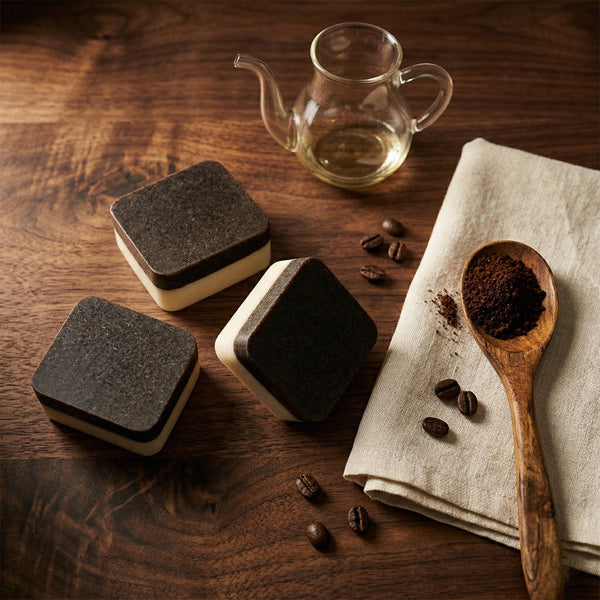
The gentlest format is a bar, not a concentrated oil—a bar keeps the oil diluted in a base of nourishing ingredients. The Cedar & Bay Leaf bar uses upcycled espresso grounds alongside bay and cedarwood, which adds mild mechanical exfoliation on the scrub side.
Bay Leaf + Cedarwood: The Pairing You’re Missing

Cedarwood and bay leaf rarely appear together in skincare. That’s the gap I like.
Both are naturally antimicrobial. Both are woody, grounding, and pleasant on the skin. But cedarwood adds depth: it’s a gentle astringent in its own right, and it rounds out bay leaf’s sharper edge. Alone, bay leaf can feel bracing. With cedarwood, the experience becomes rounded, almost meditative. You’re building a ritual, not medicating.
This is where The Reclaimed Process™ enters. The Cedar & Bay Leaf soap bar is formulated so that cedarwood and bay leaf work within a single unit, their oils distributed evenly across a palm-oil-free, organic-sourced base. The dual-sided design—one side espresso scrub, one side pure lather—lets you choose your intensity.
If you’ve been using the same bar for years, your shower has gone on autopilot. That changes with ingredients that actually do something—and bay leaf, paired correctly, does.
Start with the Cedar & Bay Leaf bar, grab a 3-Bar Pack if you want to stock up, or find a stockist near you. If you’re new to bars altogether, read how coffee skincare benefits extend beyond exfoliation—same principle, different active.
Like the way we write about skin, coffee and waste? Add us as a preferred source and Google will show you more of it.
The bar behind the blog
Everything we write about lives in this bar.
Patented 2-in-1 coffee scrub soap. Handmade in Brooklyn from grounds everyone else throws away.
Shop the bars