Why We Turn Coffee Waste Into Soap
The honest version of why 2nd Ground exists: what happens to a café's spent espresso grounds after pickup, why the bar has two sides, and what “circular” means at a Brooklyn batch table.

Every 2nd Ground bar starts with a bucket. Not a factory, not a supplier — a bucket of spent espresso grounds that a Brooklyn café was about to throw away. I've been collecting those buckets since 2015. This is the honest version of why, what happens to the grounds after I pick them up, and what "circular" actually means when you're the one standing at the batch table.
The problem I couldn't stop looking at
A busy café pulls hundreds of espresso shots a day. Every one leaves a puck of wet grounds, and almost all of it goes in the trash. Coffee grounds in a landfill don't quietly disappear — they break down without oxygen and give off methane. That's a strange fate for something that, ten seconds earlier, was a premium ingredient people paid four dollars for.
I didn't set out to start a soap company. I set out to answer a simpler question: what is a used coffee ground still good for? The answer turned out to be skin. Spent grounds are a firm, even, natural exfoliant — harder than sugar, gentler than crushed nut shell — and they still carry the caffeine and antioxidants that have made coffee a familiar skincare ingredient for years. The waste wasn't the problem. The lack of a second use was.
What "upcycled" means at our scale
Recycling breaks something down to make something of lower value. Upcycling keeps the material intact and gives it a job worth more than the one it came from. That's the whole 2nd Ground model in one sentence: grounds that were headed to landfill become the working side of a soap bar.
Here's the actual process, no mystique:
- Collect. I pick up spent grounds from partner cafés in Brooklyn — the same espresso you'd drink there.
- Dry. Wet grounds spoil fast. They're dehydrated until they're shelf-stable and clean.
- Pour. The dried grounds are worked into a bar with saponified organic coconut, olive, sunflower and castor oils and a naturally derived fragrance. That's the entire ingredient list.
- Rest and wrap. Each bar is poured by hand, rested until it's ready, and wrapped in paper.
Roughly twenty espresso shots' worth of grounds go into every bar. Multiply that by the bars we've sold and it's a meaningful pile of coffee that never reached a landfill.
Why the bar has two sides
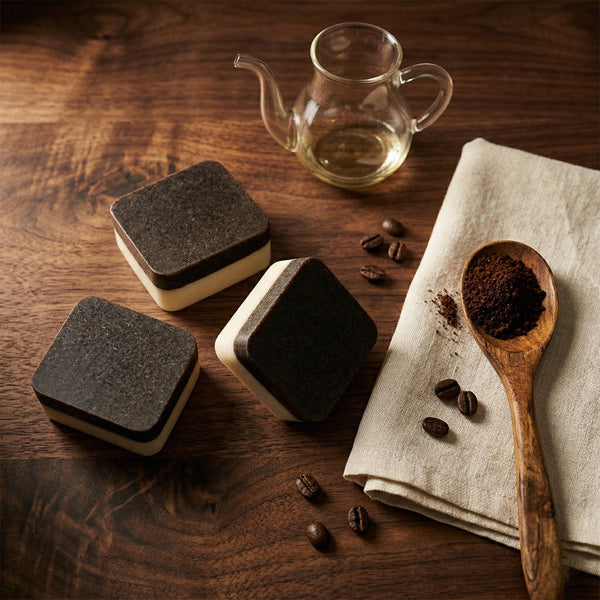
A bar with grounds all the way through means you scrub every time you wash — too much for most skin, and a waste of grounds on the days you just want to get clean. So the bar is split: a dark side packed with espresso grounds for exfoliating, and a smooth cream side for everyday cleansing. Flip it mid-shower and one bar replaces a cleanser, a scrub, and at least one plastic bottle.
That two-sided design is what the U.S. Patent Office granted us Patent No. 10,465,148 for in 2019. I mention it not to sound important but because it's the clearest proof that this isn't a novelty bar with coffee sprinkled on top. The grounds are the product.
What we leave out, on purpose
Palm oil. It's in most commercial soap because it's cheap and makes a hard bar. It's also the ingredient most tied to deforestation. We've been palm-oil-free since the first batch — there's a whole post on why we don't use palm oil.
Plastic. Every bar ships in paper. No tubs, no pumps, no shrink wrap. A bar of soap doesn't need a plastic bottle; the industry just got used to selling water in one.
Synthetic detergents and fillers. Real soap, real oils, real coffee. If an ingredient doesn't do a job on your skin, it isn't in the bar.
Circular, in practice
"Circular economy" is a phrase that gets used in a lot of pitch decks. At a batch table it's much less abstract. It means the café sends less to landfill and has a story to tell customers. It means I don't have to buy a raw material that already exists a few blocks away. It means the refilleries and boutiques that stock the bar — now across more than fifteen states — can put something on the shelf that's made of the problem it solves. And it means the person in the shower gets a better exfoliant than the plastic tub of microbeads it replaced.
Nobody in that loop is sacrificing anything. That's the part that convinced me this could be a business and not just a good idea.
Where it goes from here
Eleven years in, the plan is the same as it was in 2015: keep the ingredient list short, keep the grounds local, keep the packaging paper, and keep making every batch myself. If you want to see the bar this whole post is about, the coffee soap collection is the place to start — the Variety 3-Pack if you'd rather let your shower decide the scent. And if you run a café in Brooklyn and want your grounds to have a second life, write to me. I still pick up the buckets.
— Mark Guerino, founder, 2nd Ground
Like the way we write about skin, coffee and waste? Add us as a preferred source and Google will show you more of it.
The bar behind the blog
Everything we write about lives in this bar.
Patented 2-in-1 coffee scrub soap. Handmade in Brooklyn from grounds everyone else throws away.
Shop the bars